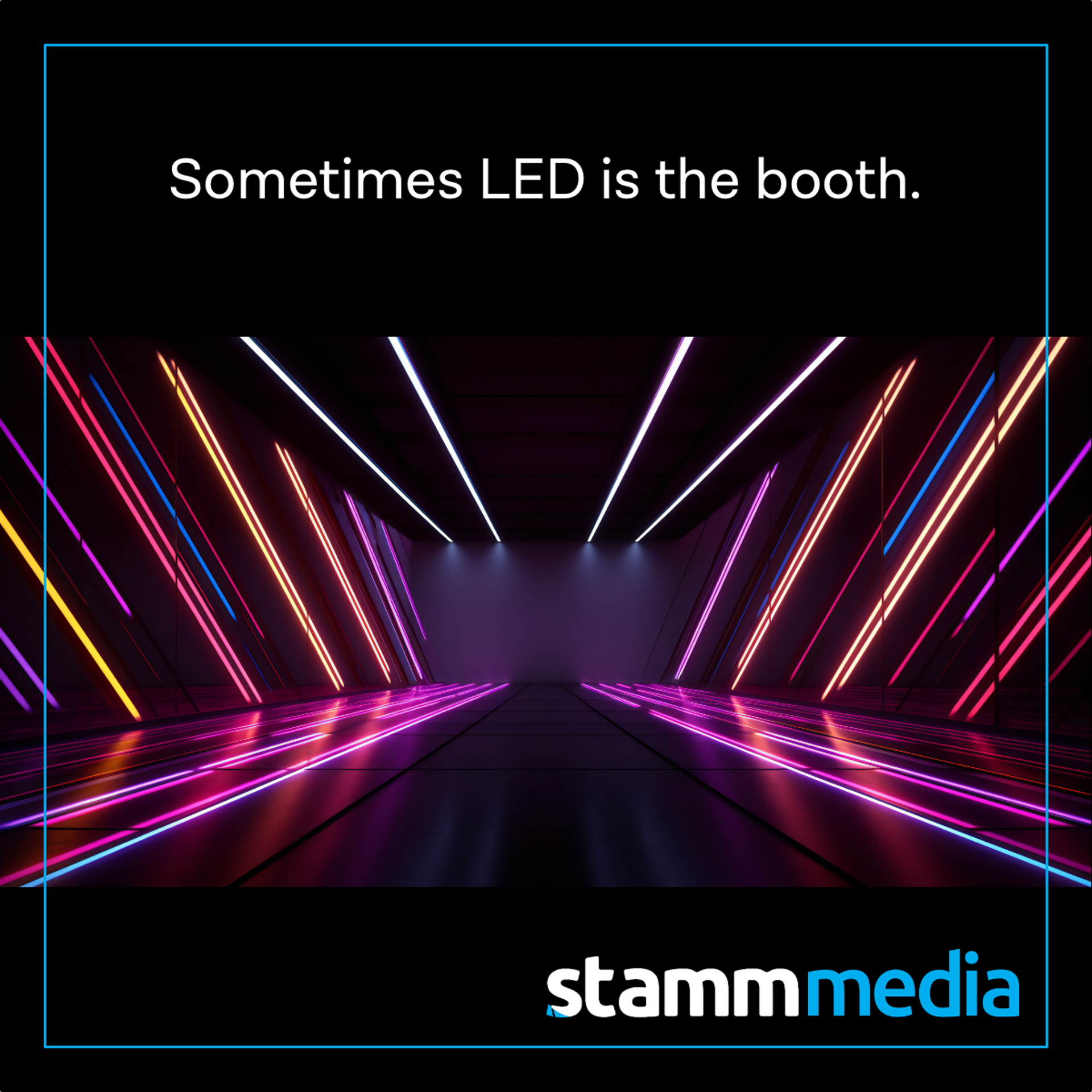
There was a time when LED in a trade show booth meant “the screen where the loop plays.”
Now? Sometimes LED is the booth.
We’re seeing more concepts where the structure itself is pixels; tunnels, wraparound walls, circular canvases, and fine-pitch hero surfaces that carry the whole story. Done well, it’s unforgettable. Done poorly, it’s a very expensive light show.
This isn’t about “more pixels everywhere.” It’s about using LED as architecture and making sure content, show operations, and story keep up.
From “screen in the corner” to “environment people walk into”
Classic LED deployment:
- One main screen
- A few supporting displays
- Content lives in a tight frame
Immersive LED shifts the question from:
“Where does the screen go?”
to
“What does it feel like to stand inside this space?”
Examples we love:
- LED tunnels that pull people through a story as they walk
- Curved or circular LED that hugs sightlines instead of fighting them
- Full-height hero walls where demos, data, and key moments land, front and center
- LED “architecture” that changes mood between product lines, sessions, or audiences
In all of those, the booth is no longer just a place to stand. It’s a place to enter.
Start with the feeling, not the pixel count
The first question we ask when a client says, “We want something immersive” isn’t, “How big can we go?”
It’s:
“What should this feel like when someone steps in?”
Do you want them to feel:
- Calm and focused, ready to absorb a complex story?
- Energized and hyped for a product launch or performance?
- Curious, like they’re stepping into a reveal?
That emotional target shapes everything:
- Content pacing - fast cuts vs slow reveals
- Color and contrast - bold and saturated vs refined and minimal
- Audio - big and cinematic vs subtle and environmental
- Time in experience - 30 seconds of “wow” or 3–4 minutes of guided story
You can’t bolt that on later. It has to be baked into the design phase, when the walls are still lines on a drawing and the content is still a sketch.
Thinking in journeys, not just loops
When LED becomes architecture, you stop designing for “viewers” and start designing for travelers.
Two questions matter a lot:
- Where do they enter from?
- Are they coming from a busy aisle, a quieter interior, or a neighboring activation?
- Do they see the wall first, or the opening into the space?
- What path do they naturally take?
- Do they walk straight through a tunnel?
- Do they pause at a hero wall?
- Do they orbit around the content like a sculpture?
Once you understand that journey, content stops being an endless loop and becomes a sequence:
- An opening moment that catches peripheral vision
- A “pull” that invites people closer or inside
- A core story beat (demo, data, product reveal)
- A closing moment or next step (talk to staff, scan a code, head to a theater)
We often sketch this as a simple storyboard before a single pixel is mapped.
Content mechanics: the unglamorous decisions that make it work
Immersive LED lives or dies on details that never show up in the mood board.
A few we obsess over:
1. Loop length and sync
- How long is someone realistically inside the space?
- How long can the loop be before it feels disjointed or confusing?
- Are multiple surfaces supposed to sync, or can they run independent looks?
A 7-minute art piece on a 30-second walk-through usually misses the moment. Most of the time, shorter, tighter loops with smart transitions win.
2. Sightlines and camera frames
We think about how this will be seen:
- From the aisle
- From inside the booth
- Through a phone camera or the show photographer’s lens
We’ll ask:
- Where does the brand show up in that frame?
- Are we avoiding “hot spots” where logos or faces get cut off?
- Does the experience photograph well for recap decks and social?
The best immersive LED environments don’t just impress in person. They look incredible in photos and video afterward.
3. Legibility and hierarchy
Even in a wraparound environment, you can’t say everything everywhere.
We prioritize:
- Where text (if any) lives, and keep it big and minimal
- Where product or message “hero moments” land
- Where ambient or abstract content lives as atmosphere only
If the entire surface is shouting, nothing gets heard.
The unsexy part: power, rigging, and show ops
When LED becomes structure, the back-of-house details get critical:
- Rigging and weight loads: Can the ceiling or structure handle the design? Is ground support required?
- Cable paths: How do we keep everything safe, clean, and accessible for service?
- Power distribution: Are we planning for realistic draw, not just theoretical minimums?
- Serviceability: If a tile fails, can it be reached without tearing down half the booth?
This is where we spend a lot of time with exhibit houses and show services, translating creative ambition into something that can be built, serviced, and signed off by the venue.
The goal isn’t to say “no.” It’s to say:
“Here’s the way we can say yes without risking the show.”
When is immersive LED the right move?
Immersive LED shines when:
- You’re launching something big and want a “you had to be there” moment
- The brand story is naturally visual and dynamic (data, journeys, environments)
- You need a hero moment that anchors the entire booth
It’s not always the right call for:
- Small booths with limited power/rigging budget
- Highly conversational programs where intimacy is better than spectacle
- Programs where assets will rarely be updated but costs would balloon
The point isn’t to make everything immersive. It’s to identify the one or two moments where “LED as architecture” actually supports the story.
Where Stamm Media fits
This is our sweet spot:
- Working with exhibit designers and brand teams to pressure-test immersive concepts
- Mapping out pixel pitch, resolution, content specs, and show routing
- Bringing the AV, IT, and operational details together so the coolest idea on the deck is also the most reliable thing on the floor
If you’re sketching a 2026 booth and wondering whether LED should be the booth or just part of it, we’d be happy to help you sort out where pixels will make the most impact.
FAQ
Q1: When does it make sense to use immersive LED instead of traditional scenic and prints?
A: Immersive LED usually makes sense when you need the environment to change either by audience, product, time of day, or show. It’s especially strong for big launches, data-heavy stories, or programs where you want a “you had to be there” hero moment. If the look is static for a year and doesn’t need motion or variation, traditional scenic and print can be a better spend.
Q2: Is immersive LED always more expensive than other scenic options?
A: The hardware and infrastructure are typically more expensive than fabric and print, but it can replace a lot of other elements. When you factor in re-use across multiple shows and the ability to update content without rebuilding scenic, immersive LED can be cost-effective over a full program, especially for brands with multiple major events on the calendar.
Q3: How early do we need to involve an LED partner if we’re thinking about tunnels or curved walls?
A: The earlier, the better. Ideally, we’re in the conversation when the first 3D concepts or floorplans are being drafted. That’s when we can help with sightlines, rigging feasibility, power planning, pixel pitch, and content specs. Bringing LED in after the design is “locked” can lead to compromises or last-minute fixes.
Q4: What kind of content team do we need for an immersive LED environment?
A: You don’t need a Hollywood studio, but you do need a team that understands motion, pacing, and legibility at scale. We usually recommend one lead motion designer plus brand creative direction. We can provide screen maps, pixel dimensions, safe areas, and content guidelines so your existing creative partners can deliver assets that work on the actual walls. If you want us to handle the creative, we can do that too.
Q5: Can immersive LED content be reused from show to show?
A: Yes, as long as it’s planned that way from the start. We often design a base “content package” that can be reused across multiple events, with modular sections that swap per audience, product, or region. That way you get consistency in look and feel, but still have room for local nuance and updates.
Q6: Is immersive LED only for huge booths and anchor sponsors?
A: Not necessarily. While the biggest, most complex builds usually sit in larger footprints, you can still use “LED as architecture” in more modest spaces. A curved hero wall, a partial tunnel, or a wraparound corner can create an immersive feel without taking over the entire show floor. The key is choosing one or two strong moves instead of trying to do everything at once.